

Start with one question: how often will it be used?
Nebulisers are not all built to do the same amount of work, and this is the distinction that matters most.
Continuous units are rated to run as often as needed, several times a day, every day. Intermittent units are built for occasional use, and some are labelled by their manufacturers for use only three to five times a week.
That difference is easy to miss on a shelf, because the two look similar and the packaging rarely leads with it. If someone is nebulising two or three times a day, an intermittent unit is the wrong machine, and it will be worked harder than it was designed for.
If in doubt, choose a continuous unit. It covers both patterns of use, and nobody has to predict how the next twelve months will go.
The three types
Compressor nebulisers
A pump pushes air through the medication to break it into a fine mist. This is the standard household nebuliser and the type most prescribed for home use.
- Best for: daily or near-daily use at home, for adults and children
- Pros: works with the widest range of medications, robust, consumables are cheap and easy to get
- Cons: mains powered, and there is an audible pump
The Able Actineb Mini is the number one selling compressor nebuliser in Australia.[1] It runs at 6.2 litres a minute at 1 bar in continuous operation, takes a 5 mL medication bowl, weighs 1.38 kg and runs at roughly 60 dBA at one metre, about the level of ordinary conversation. It comes with a bowl, tubing, mouthpiece, adult mask, child mask and five filters, so one box covers a whole household.
Portable mesh nebulisers
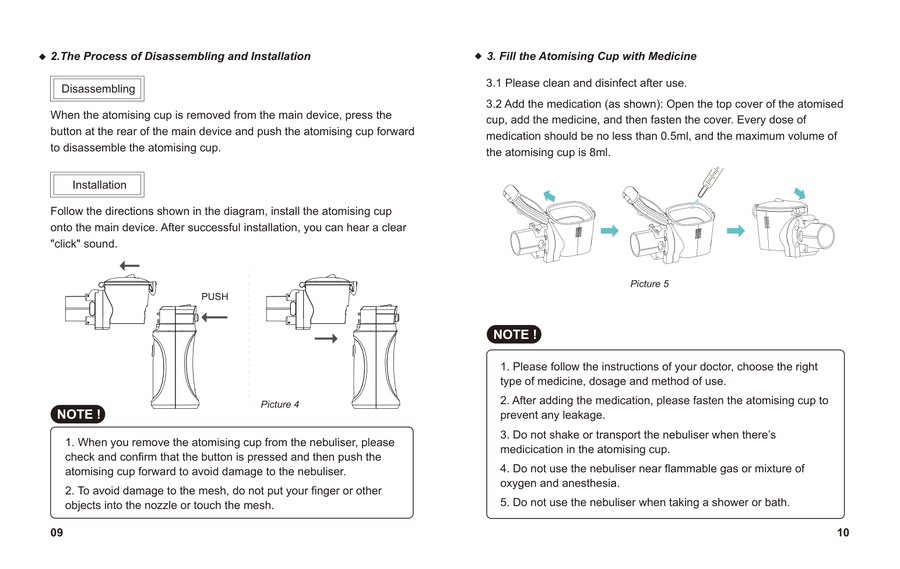
A vibrating mesh produces the mist instead of a pump. These are small, battery powered and close to silent.
- Best for: away from home: work, travel, school, the car
- Pros: pocket sized, quiet, no mains power, can be used discreetly
- Cons: not suitable for every medication, mesh needs careful cleaning, less suited to being the only unit in a daily routine
Heavy duty nebulisers
Built for sustained, high-demand use rather than a few minutes at a time.
- Best for: clinical settings, or home use where treatments are long or frequent
- Pros: built for duty cycles a household unit is not
- Cons: larger, heavier, costs more
The Able Actineb AC2000 is the heavy duty unit in our range.
Which one, by situation
| Situation | Suggested type |
|---|---|
| Daily use at home, adult or child | Compressor, the Actineb Mini |
| Occasional use at home, a few times a month | Compressor still, it costs little more and will not be outgrown |
| Needed at work, school or while travelling | Portable mesh, or a portable unit with a 12V car adaptor |
| Treatments are long, or several people use it | Heavy duty, the Actineb AC2000 |
| Main unit at home plus something for the car | Compressor at home, portable mesh in the bag |
Does it come with what you need?
Check the box contents, not just the machine. A nebuliser is only usable with a bowl, tubing, a mouthpiece or mask, and filters.
The point that catches people out is masks. A unit supplied with only an adult mask is no use for a child, and buying the mask separately afterwards costs more than choosing a unit that included it. The Actineb Mini includes both an adult and a child mask.
The parts that wear out
A nebuliser is not a buy-once item. These parts are consumable and have a service life:
- Medication bowl, the part that does the work, and the part that wears first
- Tubing or driveline, which perishes and discolours over time
- Masks and mouthpieces, which perish, harden and stop sealing
- Air filters, which need regular replacement to protect the pump
The Able Nebuliser Kit is the biggest selling nebuliser line in Australia,[1] which is the practical reason to check your consumables are easy to get before you buy a machine.
Running a nebuliser on a tired bowl or a blocked filter is the most common reason a machine seems to have "stopped working well". It usually has not failed; it needs servicing.
If output has dropped, treatments are taking longer than they used to, or the unit has become noisy, replace the consumables before replacing the machine. If that does not fix it, we repair and service nebulisers of all brands, not only our own.
Looking after it
- Wash the bowl, mouthpiece and mask after each day's use, following the instructions supplied
- Let everything air dry fully before reassembling
- Never wash tubing. If it has moisture inside, run the unit with the tubing attached and no medication until it clears, or replace it
- Replace filters at the interval in your instructions, and sooner in a dusty house or with pets
- Keep the air inlet clear and the unit off carpet while running
Frequently asked questions
How long should a treatment take? It depends on the medication and volume. What matters is the trend: if treatments are taking noticeably longer than they used to, suspect the bowl or filter first.
Can I use any medication in any nebuliser? No. Some medications are not suitable for mesh nebulisers in particular. Check with your pharmacist.
How loud is a nebuliser? A compressor unit is audible. The Actineb Mini is approximately 60 dBA at one metre, roughly the level of normal conversation. Mesh units are far quieter.
Can children use the same nebuliser as adults? Yes, with the right mask. The machine does not change, the mask does.
Do you service nebulisers you did not sell? Yes. We service all brands.
Always follow the instructions for use supplied with your device, and your doctor's or pharmacist's advice on your medication. This article is general information, not medical advice.
References
- IQVIA Retail, national sell-in units, moving annual total to May 2026. Compressor nebuliser category, Australian pharmacy (ultrasonic, portable mesh, kits, masks and accessories excluded from the compressor share figure).
- ABLE Actineb Mini specifications from the product instructions for use, issue 6 (Australia).


