

The short answer
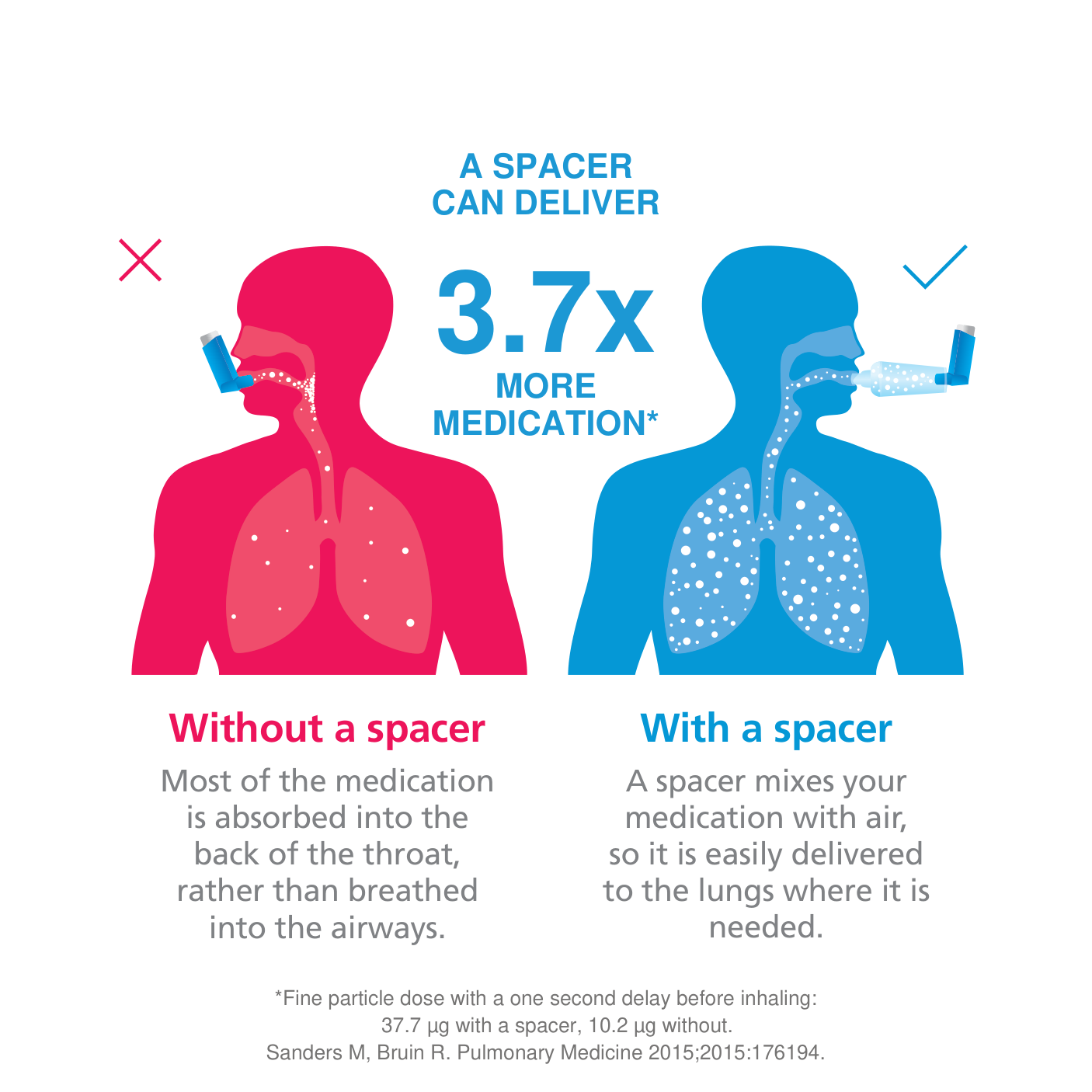
If you use a puffer, you should almost certainly be using a spacer with it. A spacer helps deliver more of your medication to the lungs rather than the throat. Hesitate for one second between firing the puffer and breathing in, which is the commonest mistake there is, and a spacer delivers 3.7 times as much to the airways.[1]
That figure surprises people, because a puffer feels like it is working. You press it, you taste it, something has clearly happened. The problem is where the medication actually lands.
What happens without a spacer
A puffer fires medication out at speed. Co-ordinating a slow, deep breath with that spray is genuinely difficult, and most people do not manage it, including adults who have used one for years.
When the timing is even slightly out, most of the dose hits the back of the throat and is absorbed there instead of reaching the airways. You get the taste, the throat irritation and sometimes a hoarse voice, but the medication is not doing its job where it is needed.
What happens with a spacer
A spacer is a chamber that sits between the puffer and your mouth. When you fire the puffer into it, the medication is held in the chamber and mixed with air, which slows the spray down and breaks it into finer particles.
That does two useful things:
- It removes the timing problem. You no longer have to press and breathe at the same instant. You fire into the chamber, then breathe normally.
- It gets the particles deeper. Slower, finer particles travel past the throat and into the airways, which is where they are supposed to act.
This is why spacers are recommended for children, for anyone having an asthma flare-up, and for most adults using a preventer.
Who needs one
Children. Co-ordination is the main issue. Children under about five also need a mask with the spacer rather than a mouthpiece, sized to their age. See the mask size guide.
Anyone using a preventer. Preventers contain corticosteroids. Medication left in the mouth and throat is the main cause of oral thrush and hoarseness, and a spacer reduces how much is deposited there.
Anyone during an asthma flare-up. When you are short of breath, slow deep breathing is hardest. A spacer lets you take several normal breaths from the chamber instead.
Older adults. Grip strength, breath control and co-ordination all make a puffer harder to use well.
How to use a spacer
- Shake the puffer and remove the cap.
- Fit the puffer into the opening at the back of the spacer.
- Put the mouthpiece in your mouth and close your lips around it. If you are using a mask, hold it gently but firmly over the nose and mouth.
- Press the puffer once.
- Breathe in and out normally four or five times through the spacer.
- If a second dose is needed, wait about 30 seconds, shake the puffer again and repeat.
Two things people get wrong: firing two or three doses into the chamber at once, which makes the particles clump and settle rather than stay suspended; and holding the mask loosely, which lets the dose escape around the edges.
A note on static
Ordinary plastic spacers build up a static charge, and that charge pulls medication onto the inside wall of the chamber instead of letting it stay in the air for you to breathe. It is one of the quieter reasons a spacer can underperform.
The Able Spacer is made from an anti-static polymer, so the medication stays suspended in the chamber where it is useful.
The Able Spacer
The Able Spacer is Australia’s number one spacer range.[2] It was voted Product of the Year 2018 in the First Aid category, from a Nielsen survey of 13,500 Australians. It is anti-bacterial, anti-static and BPA free, and it is the only spacer with silver ion technology built into the plastic itself.
It also uses a heart valve rather than the butterfly valve found on some spacers. You can see the valve move as you breathe, and because it closes properly it will not sit open and let medication escape if the user does not exhale through the chamber. The chamber is 210 mL, which is the volume consistent with optimal performance, and the puffer stores inside it.
That silver ion point matters more than it sounds, because spacers get dirty in a way most people never think about. There is a separate article on that: how to clean a spacer, and why the material it is made from matters.
Frequently asked questions
Do I need a spacer if I only use my puffer occasionally? Yes. The co-ordination problem is the same whether you use a puffer daily or twice a year, and occasional users tend to be less practised, not more.
Can I use any spacer with any puffer? Most standard metered-dose inhalers fit standard spacers. If your puffer is an unusual shape, check the fit before you buy.
How often should a spacer be replaced? Follow the instructions supplied with your spacer. In general, annually. Replace it sooner if it is cracked, cloudy, or if the valve is damaged or sticking.
Does a spacer work for children? Yes, and for young children it is the recommended way to give puffer medication. Under about five, use a mask rather than a mouthpiece, sized to the child.
Always follow the instructions for use supplied with your device, and your doctor’s or pharmacist’s advice on your medication. This article is general information, not medical advice.
References
- Sanders M, Bruin R. A rationale for going back to the future: use of disposable spacers for pressurised metered dose inhalers. Pulmonary Medicine 2015;2015:176194. Fine particle dose of salbutamol through a DispozABLE Spacer against a pMDI alone, with a one second delay before inhalation.
- IQVIA Retail, national sell-in units, moving annual total to May 2026. Spacer category, Australian pharmacy.
- Valved holding chamber face masks: material and design contributors to delivery performance and hygiene. Respiratory Drug Delivery 2017;2:207–210.
 Able Spacer Anti-Bacterial
 Able Spacer with Medium Mask
 Able Spacer with Small Mask
 Able Collapsible Spacer