

Why breathing speed matters
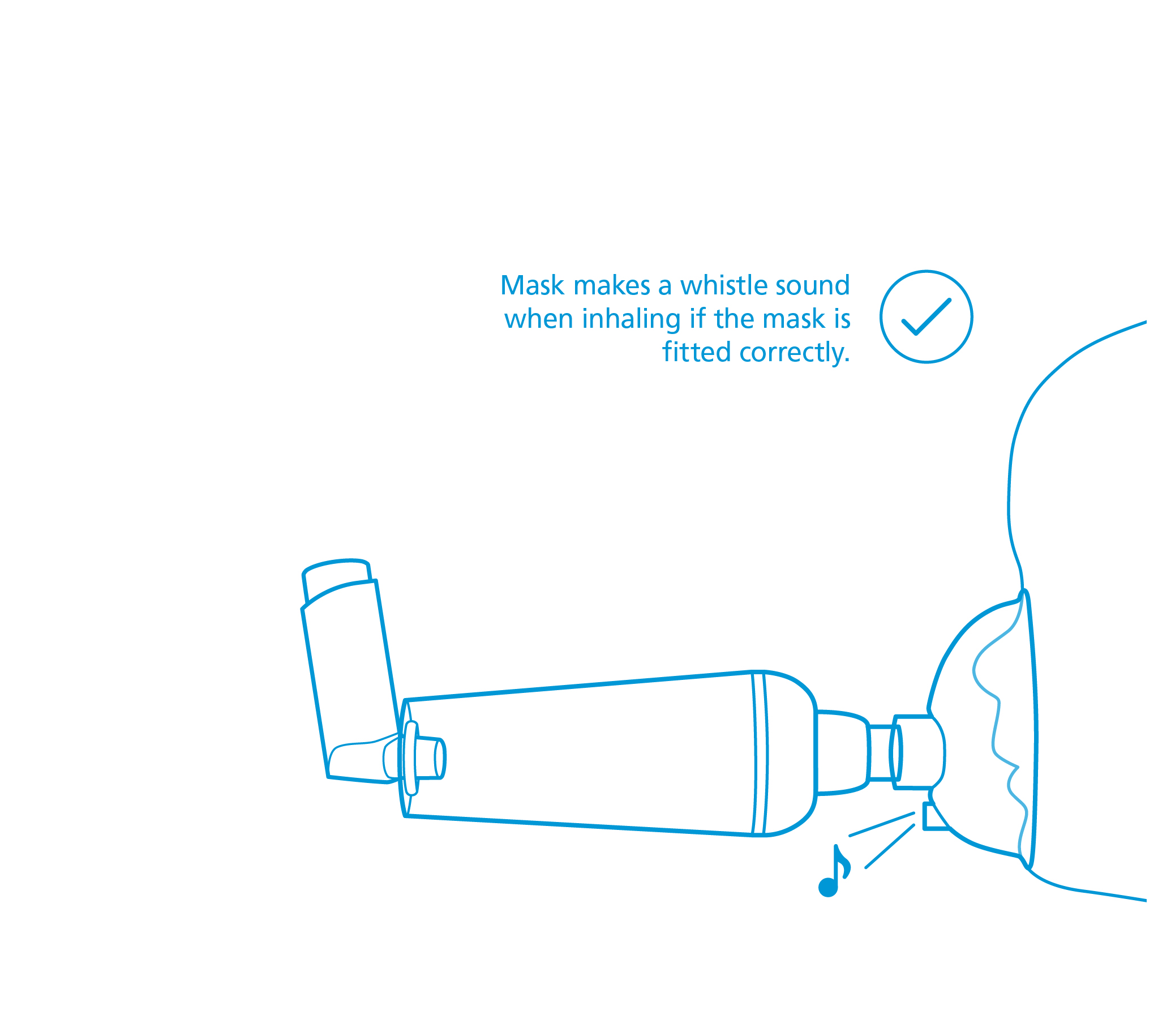
A spacer solves the timing problem. It does not solve the speed problem.
If you breathe in fast and sharp, the medication is thrown against the back of the throat and stops there. Slow and steady lets the fine particles travel past the throat and into the airways.
Telling someone to "breathe in slowly" is easy. Knowing whether they did is not, and that is the gap a whistle fills.
How the coaching whistle works
A small reed in the mask or device sounds once the breath reaches the right speed. The whistle is the target, not a warning.
So the instruction becomes simple and self correcting: breathe steadily enough to keep the whistle going, right through the breath. No counting, no judgement, no guessing.
For a child it turns an abstract instruction into a game with immediate feedback. For an adult it turns an opinion into a measurement.
The Able whistle masks
The Able Spacer small and medium masks are whistle masks, which covers the age groups least able to follow a spoken instruction: under 2, and 2 to 5.
The whistle is doing real work here, not entertaining. It only sounds when the mask is sealed properly against the face and the child is drawing a steady breath, so the sound is confirmation that both halves are right. A child chasing a noise is a child co-operating rather than fighting the mask.
Flo-Tone CR
Flo-Tone CR is a different approach to the same problem. It is a mini spacer and inhaler training aid in one, small enough for a pocket, and it clips directly onto most puffers.
It is bought separately, not supplied with the Able Spacer.
It signals the same way the mask whistle does: it sounds when you reach the right flow rate, and the signal to press the puffer is the whistle itself. Keep the whistle going and the dose is drawn deep into the lungs.
Controlled Resistance is the engineering behind it. Different puffers have different internal resistance, so a simple whistle would sound at a different breath speed on each one. The controlled resistance means the whistle responds at the same flow rate whichever inhaler it is fitted to, between 20 and 30 litres a minute.
What the testing showed
Laboratory testing using Next Generation Impactor methods compared two combination asthma inhalers with and without Flo-Tone CR.[1]
| Without Flo-Tone CR | With Flo-Tone CR | |
|---|---|---|
| Dose left on the actuator, inhaler 1 | 12.0% | 5.1% |
| Dose left on the actuator, inhaler 2 | 13.6% | 5.7% |
The fine particle dose, the fraction small enough to reach the airways, was essentially unchanged. In other words it moved the medication out of the mouthpiece and throat without costing anything where it matters.
The authors described it as a remarkable improvement in throat deposition, with a mini spacer function and no adverse effect on fine particle dose.
Two ways to breathe with Flo-Tone
The Able Spacer instructions give two methods, and say to use whichever works better for you.[2]
Method 1, the one recommended with Flo-Tone. Start a slow, deep breath in through the mouthpiece, keeping the whistle going for as long as you can. Take the mouthpiece away and hold your breath for as long as is comfortable.
Method 2. Breathe in and out through the mouthpiece at least twice, then take it away and breathe normally.
Method 2 works just as well and will not damage the device, but you will not get the same result from the whistle, because the whistle is reporting on a single sustained breath.
Either way: one dose at a time. Fire the puffer once, breathe, then repeat if a second dose is needed.
Who should use which
| Situation | Device |
|---|---|
| Child under 5 | Able Spacer with a whistle mask |
| Someone whose timing is the problem | A spacer |
| Someone whose breathing speed is the problem | Flo-Tone CR |
| Pharmacist or nurse teaching technique | Flo-Tone CR with a placebo inhaler |
| Someone who will not carry a full spacer | Flo-Tone CR |
The two are not alternatives so much as answers to different faults. A spacer removes the need for timing. Flo-Tone teaches the breath.
Looking after it
- Wash in warm soapy water and let it air dry naturally
- Do not dry or rub with a cloth, and there is no need to rinse
- Blow through it once before use, to clear any water from the whistle
- Store somewhere clean and dry, and always make sure it is dry before use
- With normal daily use, replace it every 12 months
It is a single patient device.
The Able Spacer is not dishwasher proof, and should not be sterilised. Wash it by hand, in warm soapy water, and let it air dry. Heat distorts the chamber and damages the valve.
Frequently asked questions
My spacer does not whistle. What is wrong? Usually the mask is not sealed against the face, or the breath is too gentle. Check the fit first, then breathe in a little more strongly.
Flo-Tone does not whistle at all. What is wrong? Usually the breath is too gentle, or there is water in the whistle. Blow through it once and try again.
Is Flo-Tone a replacement for a spacer? It has a mini spacer function, but for a young child, or anyone who cannot co-ordinate a puffer, a full spacer with the right mask is the right device.
Can a whistle mask be used with any Able spacer? The Able masks fit the Able Spacer. The spacer does not change, only the mask.
This article is general information, not medical advice. Always follow the instructions for use supplied with your device.
References
- Sanders M, Tran C. Impact of a pMDI-technique training device on combination asthma therapy pharyngeal steroid deposition. IPCRG 2018. Clement Clarke International Limited, Harlow, and i2c Pharma Services, Cardiff.
- Able Spacer with Flo-Tone instructions for use, Clement Clarke International, part 19058982, issue 1.
- Flo-Tone CR product information, Clement Clarke International, FC8387A.


