

What atrial fibrillation is
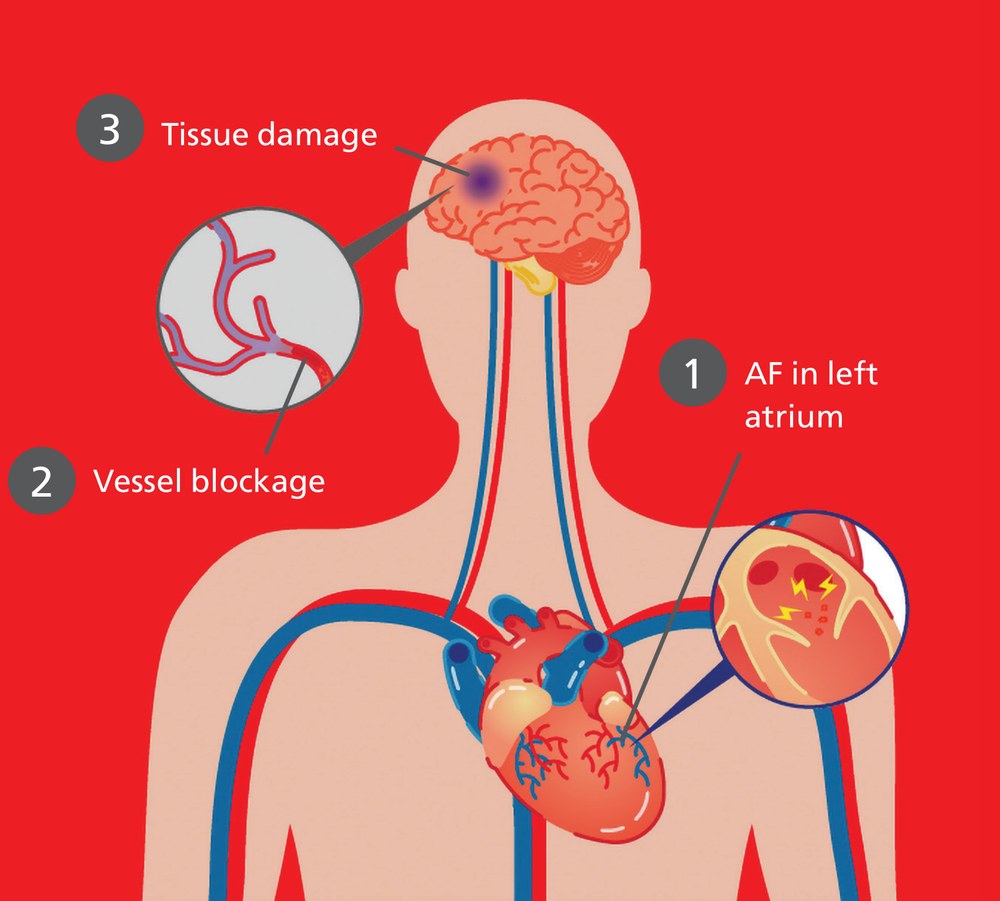
In atrial fibrillation, usually shortened to AF or AFib, the upper chambers of the heart beat chaotically and irregularly instead of in a steady rhythm.
That irregular beat lets blood pool in the atria rather than moving through cleanly. Pooled blood can clump and form a clot. If a clot travels to the brain and blocks a vessel there, the result is a stroke.[1]
Why it matters more than most people realise
- AF is the most common sustained heart rhythm disorder, occurring in about 5% of people over 65 and 14% of people over 85.[1]
- It raises the risk of stroke roughly five-fold, and is responsible for about 20% of all strokes.[1]
- Around 33.5 million people worldwide are affected.[1]
- Detected early and treated appropriately, the associated stroke risk can be reduced by as much as 68%.[2]
That last figure is the reason this article exists. AF is a condition where finding it early changes the outcome substantially.
The problem: it usually has no symptoms
This is what makes AF different from most heart conditions.
Around 70% of AF episodes produce no symptoms at all.[1] Roughly 40% of people with AF never notice anything.[1] Many are only diagnosed by coincidence, when they are in hospital for something else, and for some people that something else is the stroke itself.
There is a second problem. In its early stages AF comes and goes. It can be absent during a GP appointment and present an hour later, so even a careful check at the surgery can miss it.
Something that checks regularly, at home, over weeks rather than minutes, is far more likely to catch an intermittent rhythm than an occasional visit.
Who is more at risk
- Age
- High blood pressure
- Diabetes
- Existing cardiovascular disease
- Stress
- Smoking
- Alcohol
- Obesity[1]
The overlap with high blood pressure is the practical point. A great many people already measuring their blood pressure at home sit in more than one of those categories, which is why screening during the blood pressure reading makes sense: no extra device, no extra appointment, no extra effort.
How screening during a blood pressure reading works
A blood pressure monitor is already measuring your pulse as it deflates the cuff. A monitor with AF detection analyses the rhythm of that pulse while it measures, and if the pattern looks like atrial fibrillation, an AFIB symbol appears on the display alongside your reading.
It does not diagnose anything. That is important and worth being clear about. The monitor flags a rhythm worth looking at. Diagnosis is made by a doctor, usually with a 12-lead ECG.[1]
Why it measures three times
Monitors with AFIB technology take three measurements in sequence automatically, then average them.
That is not padding. A systematic review of the clinical evidence found the highest sensitivity, 97%, came from three sequential measurements with two or three of them positive for AF, and the highest specificity, also 97%, from three sequential measurements all positive.[2] Three readings is simply the most reliable way to do it.
"Irregular heartbeat" is not the same thing
Many blood pressure monitors carry an irregular heartbeat symbol, and it is easy to assume that is AF detection. It is not.
An irregular heartbeat indicator exists mainly to warn you that the reading itself may be unreliable because of an irregular rhythm.[3] It does not distinguish between types of arrhythmia, so it also flags harmless ones such as sinus arrhythmia, premature atrial contractions and a slow heart rate. The result can be a worrying symbol that means very little.
AF detection is a different thing: a specific algorithm looking for atrial fibrillation in particular.
If AF screening is the reason you are buying, check that the monitor actually detects AF, not just an irregular beat.
What to do if the AFIB symbol appears
- Do not panic. The symbol is a prompt, not a diagnosis, and AF is very treatable once known about.
- Keep measuring as normal, at the same times each day, and note which readings show the symbol.
- Take the record to your doctor. A pattern across days is far more useful than a single flag.
- Expect an ECG. A 12-lead ECG is how AF is confirmed.
Equally, no symbol is not a guarantee of no AF. If you have symptoms such as palpitations, breathlessness, chest discomfort or unusual fatigue, see your doctor regardless of what the monitor shows.
Which monitors screen for AF
In the Able range, the B3 AFIB Advanced carries AFIBsens Advanced along with SmartMAM averaging, and is clinically validated to the BIHS protocol at grade A/A.
Frequently asked questions
Can a blood pressure monitor diagnose atrial fibrillation? No. It can flag a rhythm consistent with AF during a measurement. Diagnosis is made by a doctor, usually with an ECG.
I have no symptoms. Should I still screen? Around 70% of AF episodes cause no symptoms, so having none does not rule it out. Risk rises with age and with high blood pressure.
Is AF dangerous? Untreated it carries a substantially raised stroke risk. Treated, that risk can be reduced considerably. Which is the argument for finding it.
How often should I screen? Taking your blood pressure as your doctor has advised means you are screening at the same time. Regular measurement over weeks is what catches an intermittent rhythm.
This article is general information, not medical advice. If you have any concern about your heart rhythm, see your doctor.
References
- Microlife AFIB technology information sheet, Microlife AG, drawing on: Zoni-Berisso M et al, Clinical Epidemiology 2014;6:213-220; Boriani G et al, American Journal of Medicine 2015;128:509-518; Sanna T et al, New England Journal of Medicine 2014;370:2478-2486.
- Verberk WJ, Omboni S, Kollias A, Stergiou GS. Screening for atrial fibrillation with automated blood pressure measurement: research evidence and practice recommendations. International Journal of Cardiology 2016;203:465-473.
- Alpert BS, Quinn D, Gallick D. Oscillometric blood pressure: a review for clinicians. Journal of the American Society of Hypertension 2014;8:930-938.


