

The simple answer
A spacer is a hollow plastic chamber that sits between your puffer and your mouth.
You fire the puffer into the chamber rather than straight into your throat, then breathe the medication out of the chamber in your own time.
It is sometimes called a valved holding chamber, because a one way valve at the mouthpiece holds the dose in the chamber until you breathe in.
What it is made of
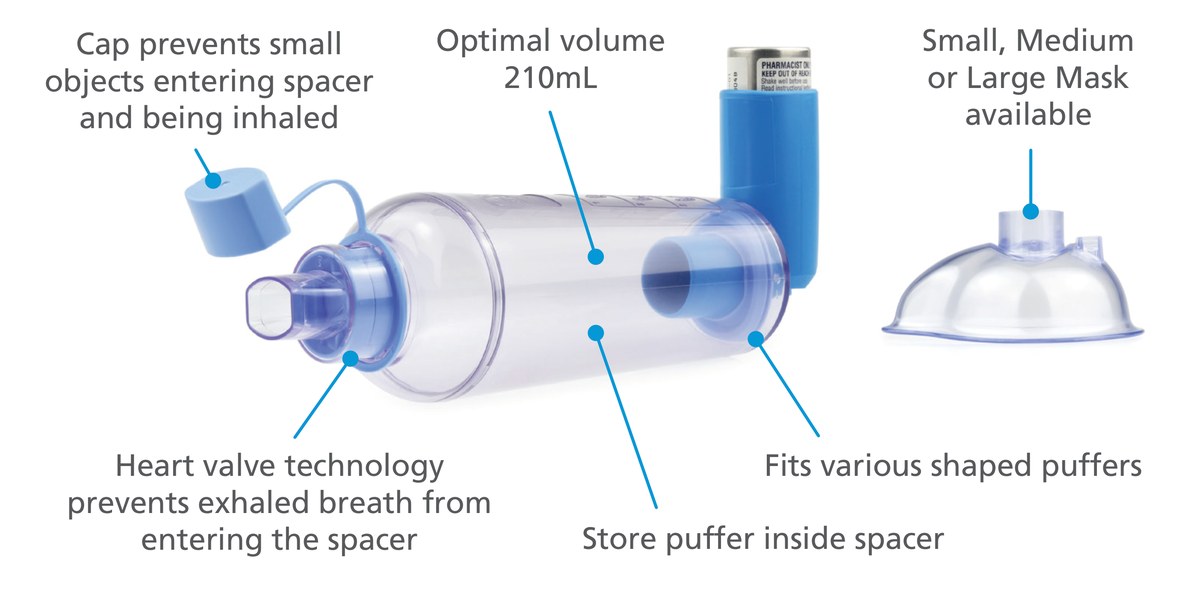
A spacer has three parts:
- The chamber, which holds the medication after the puffer fires
- The valve at the mouthpiece end, which opens as you breathe in and closes as you breathe out
- Thepuffer port, shaped to take the mouthpiece of a standard puffer
Spacers can be used with a mask instead of a mouthpiece, for young children and for adults who may need to inhale through their nose or mouth.
What it actually does
Three things, and they all follow from slowing the spray down.
It gives you time. A puffer releases its dose in a fraction of a second. Without a spacer you have to press and breathe in at exactly the same moment. With one, the dose waits in the chamber for you.
It slows the particles. Medication leaves a puffer fast. The chamber lets it mix with air and lose speed, so it is far less likely to hit the back of the throat and stop there.
It makes the particles finer. The larger droplets fall out inside the chamber instead of landing in your mouth. What you breathe in is the finer fraction, which is the part that can travel into the airways.
Why that matters
The medication in a puffer is meant to reach the airways in your lungs. Anything that lands in your mouth or the back of your throat is not doing that job, and it is the main cause of the taste, the throat irritation and the hoarseness people associate with preventers.
Used perfectly, a puffer on its own gets almost as much medication down as a puffer with a spacer. The difficulty is the timing. Delay breathing in by a single second, which is the commonest mistake, and a spacer delivers 3.7 times as much medication to the airways.[1]
Is a spacer the same as a nebuliser?
No, and they are often confused.
- A spacer is used with a puffer. No power, no medication of its own, nothing to switch on. It changes how the puffer's dose is delivered.
- A nebuliser is a machine that turns liquid medication into a mist you breathe over several minutes.
For most people and most situations, a puffer with a spacer does the job that was once done with a nebuliser, and does it faster.
Do I need a prescription?
No. Spacers are available over the counter at pharmacies. The medication in your puffer may need a prescription, but the spacer itself does not.
The Able Spacer
The Able Spacer is Australia's number one spacer range.[2] It is anti-bacterial, anti-static and BPA free, with a 210 mL chamber and a heart valve you can see moving as you breathe. The puffer stores inside the chamber, so the two stay together.
Frequently asked questions
Is a spacer only for children? No. Adults benefit just as much, and the co-ordination problem a spacer solves does not disappear with age.
Can I use a spacer with any puffer? Most standard metered dose inhalers fit standard spacers. If your puffer is an unusual shape, check the fit.
Does a spacer contain medication? No. The medication is in your puffer. A spacer only changes how it is delivered.
How long does a spacer last? Follow the instructions supplied, but in general it should be replaced annually Replace it sooner if it is cracked, cloudy, or the valve sticks.
This article is general information, not medical advice. Always follow the instructions for use supplied with your device, and your doctor's or pharmacist's advice on your medication.
References
- Sanders M, Bruin R. A rationale for going back to the future: use of disposable spacers for pressurised metered dose inhalers. Pulmonary Medicine 2015;2015:176194. Fine particle dose of salbutamol through a DispozABLE Spacer against a pMDI alone, with a one second delay before inhalation.
- IQVIA Retail, national sell-in units, moving annual total to May 2026. Spacer category, Australian pharmacy.


