

How often should you clean a spacer?
Wash it before you use it for the first time, and then at least once a week in normal daily use.[6] Wash it more often if the person using it has been unwell, or if you can see residue inside the chamber.
Weekly surprises people who assumed a spacer was a wipe-and-forget item. It is the interval in the Able Spacer instructions, and given what grows inside a warm damp chamber it is the right one. Follow the instructions supplied with your own spacer, as they vary between brands.
How to wash a spacer properly
- Take it apart as far as the instructions allow. Usually the chamber separates, and the mask comes off if you use one.
- Wash in warm water with a little dishwashing detergent. Let the parts soak for a few minutes.
- Do not scrub the inside of the chamber. Scrubbing scratches the plastic and makes static worse, which is the opposite of what you want.
- Do not rinse. This is the step almost everyone gets wrong. The Able Spacer instructions put it plainly: there is no need to rinse the parts, because the soapy residue helps to improve drug delivery.[6]
- Let it air dry standing up. Do not dry the inside with a tea towel or paper towel, for the same reason: it reintroduces static and leaves fibres behind.
- Reassemble only when completely dry.
The Able Spacer is not dishwasher proof, and should not be sterilised. Heat distorts the chamber and damages the valve. Wash it by hand. The same applies to most spacers, but check the instructions for the one you own.
Why "do not rinse, do not towel dry" matters
Plastic builds up a static charge. Inside a spacer, that charge attracts the medication onto the chamber wall the moment you fire the puffer, so less of it stays suspended in the air for you to breathe.
The detergent film left after washing reduces that charge. Rinsing it off, or rubbing the inside dry, puts the static straight back. It is a small habit that measurably changes how much medication you actually get.
The Able Spacer uses an anti-static polymer, so it is less dependent on this than an ordinary spacer. The washing routine above is still worth following.
The part people do not think about
A spacer is a warm, damp, enclosed plastic chamber that you breathe into repeatedly. That is close to ideal conditions for bacteria.
This is not a theoretical worry, and it has been measured more than once.
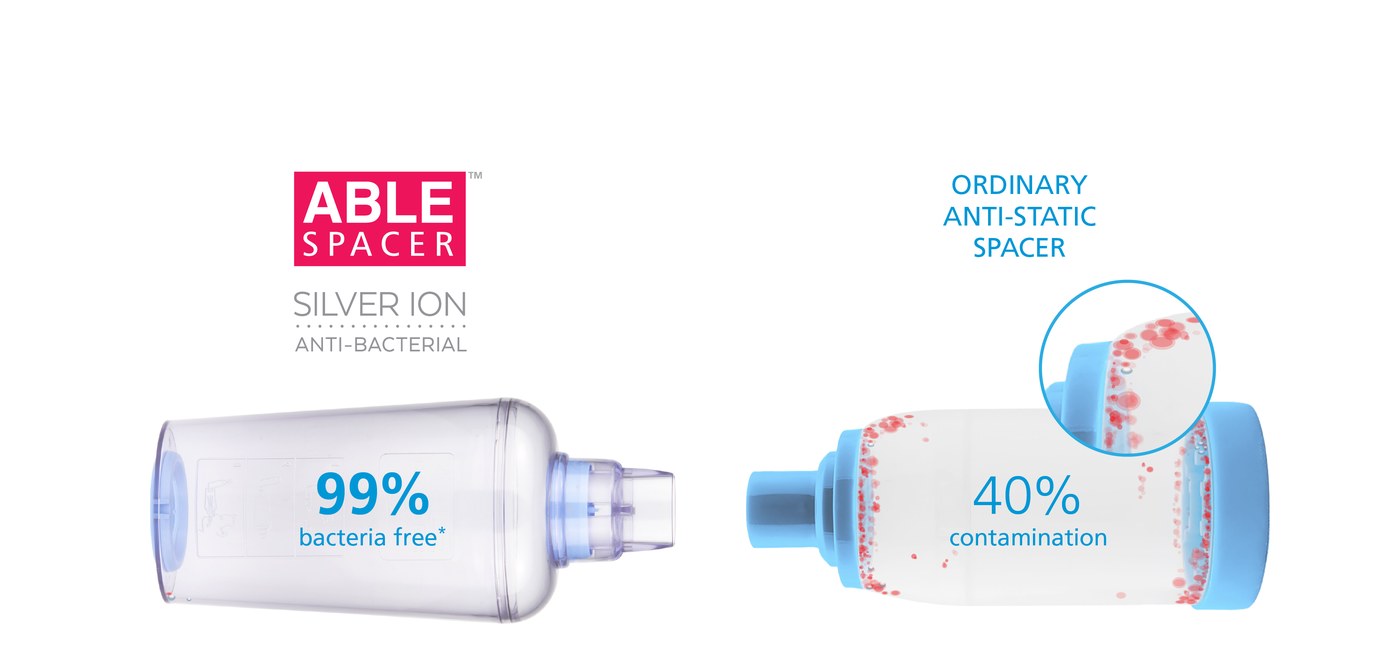
- A study of 180 children using spacers found 40% carried pathogenic bacteria, most commonly Pseudomonas aeruginosa.[1]
- An earlier study of 62 asthmatic children found bacterial contamination in 35.5% of spacer reservoirs and 25.8% of masks.[2]
- Klebsiella pneumoniae has been shown to survive on the plastic body of a valved holding chamber.[3]
The concern is not the spacer itself but what it then delivers: you are breathing through that chamber directly into your airways.
Regular cleaning helps. It does not solve it between washes.
What silver ion technology does
The Able Spacer Anti-Bacterial is the only spacer with silver ion embedded in the polymer itself. It is not a coating that wears off, it is part of the material.
When bacteria come into contact with a silver ion protected surface, the silver ions interfere with the bacteria's ability to multiply, so they die rather than colonise the chamber.
Independent testing to ISO 22196, the international standard for measuring antibacterial activity on plastic surfaces, shows the Able Spacer surface as 99% bacteria free.[4]
The Able Spacer is also Australia's number one spacer range.[5]
In plain terms: an ordinary spacer is clean when you have just washed it, and gradually stops being clean until you wash it again. A silver ion spacer works on that problem continuously.
Signs it is time to replace a spacer
- The chamber is cracked, cloudy or deeply scratched
- The valve is torn, stiff, sticking or no longer moves freely
- The mask has perished, hardened or no longer seals against the face
- It has been dropped and anything inside has distorted
Replace it when any of those apply, and otherwise at the interval given in your instructions for use. Masks usually need replacing more often than chambers, particularly children's masks, which get the most handling.
Frequently asked questions
Can I boil a spacer to sterilise it? No. The Able Spacer should not be sterilised. Heat distorts the chamber and damages the valve.
Can a spacer go in the dishwasher? Not the Able Spacer, for the same reason. Wash it by hand in warm soapy water.
Why does my spacer look foggy inside? Usually a build-up of medication residue, which means it is overdue for a wash. If washing does not clear it, or the plastic itself has gone cloudy, replace it.
Do I need to clean a new spacer before first use? Yes. Wash it before the first use, then follow the normal routine.
Does an anti-bacterial spacer still need washing? Yes. Silver ion technology addresses bacteria on the surface, not medication residue. Wash it on the normal schedule.
Always follow the instructions for use supplied with your device. This article is general information, not medical advice.
References
- Kumar R, Prabhakaran K, Kumar P, Tak V, Abhishek KS, Goyal JP. Bacterial contamination of spacer devices used by asthmatic children: a cross-sectional study. Indian Pediatrics 2026;63(1):7–12. (180 children; 40% pathogenic isolates.)
- Cohen HA, Cohen Z, Pomeranz AS, Czitron B, Kahan E. Bacterial contamination of spacer devices used by asthmatic children. Journal of Asthma 2005;42(3):169–172.
- Sanders M, Bruin R. Klebsiella pneumoniae survival on plastic valved holding chamber (VHC) bodies. Thorax 2014;69(Suppl 2):A114.
- Demonstrated by ISO 22196 tests in published studies.
- IQVIA Retail, national sell-in units, moving annual total to May 2026. Spacer category, Australian pharmacy.
- Able Spacer with Flo-Tone instructions for use, Clement Clarke International, part 19058982, issue 1.


