

Why this matters more than the monitor
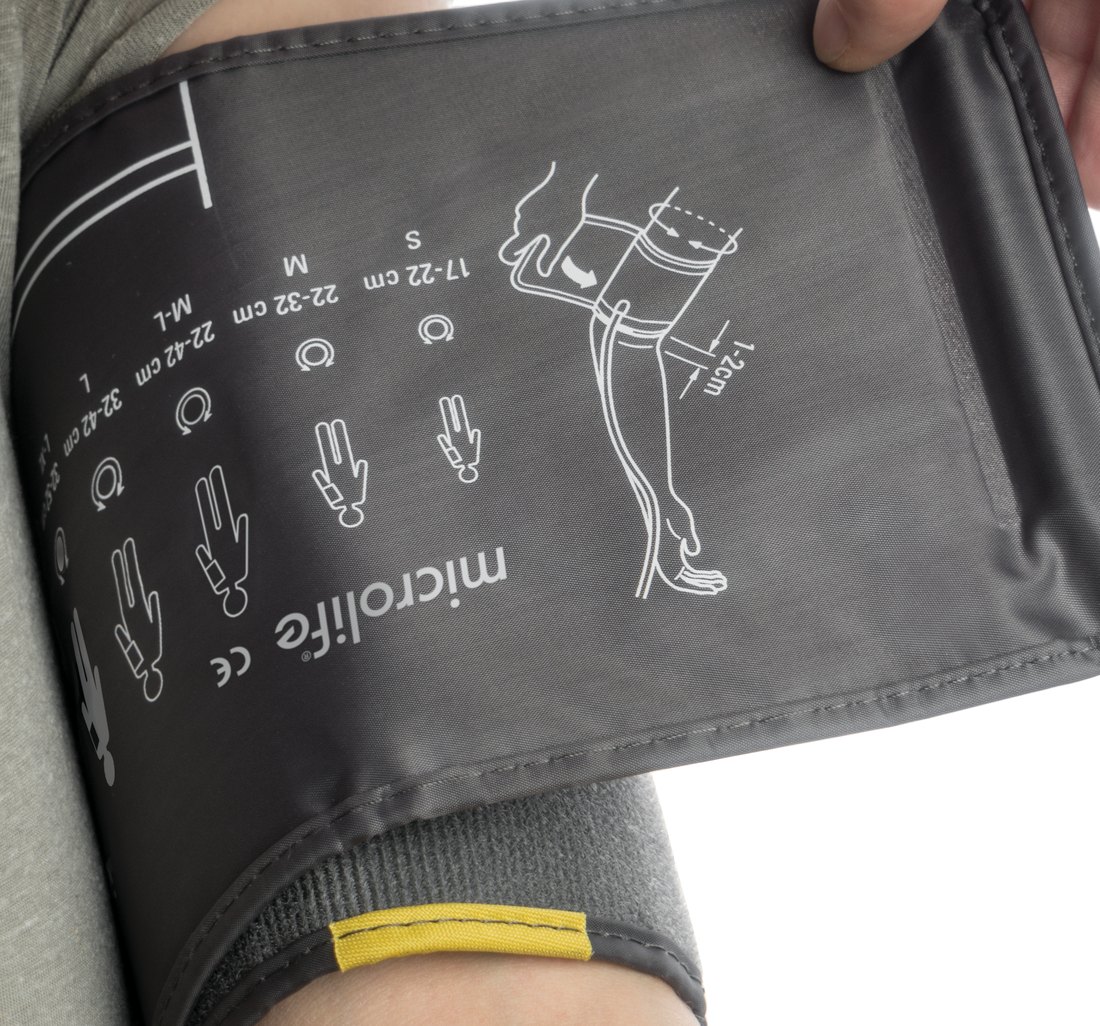
A cuff that does not match your arm is the largest single source of error in home blood pressure measurement. Using one that is too small can push a systolic reading up by 10 to 40 mmHg.[1]
To put that in perspective, it is more than enough to turn a normal reading into one that looks like hypertension. No amount of accuracy in the monitor can correct for it, because the monitor is measuring correctly. It is measuring the wrong thing.
Measure your arm first
Do not guess from clothing size or general build. Measure.
- Bare your upper arm and let it hang relaxed by your side.
- Find the midpoint between the point of your shoulder and your elbow.
- Measure around the arm at that midpoint with a tape measure, snug but not tight.
- Note the measurement in centimetres.
If you do not have a tape measure, a length of string marked and then laid against a ruler works. If you are between two sizes, ask your pharmacist, who can measure for you.
The size chart
| Cuff size | Arm circumference |
|---|---|
| S | 17 to 22 cm |
| M | 22 to 32 cm |
| M-L | 22 to 42 cm |
| L | 32 to 42 cm |
| L-XL | 32 to 52 cm |
Most Able monitors are supplied with a cuff covering 22 to 42 cm, which fits the majority of adult arms. If your measurement falls outside that, or sits right at the edge, a different cuff is available separately and you do not need a different monitor.
If you are between sizes, the range markings printed on the cuff itself are the final word. Your arm circumference should sit inside the index markings when the cuff is wrapped, not past either end.
Fitting it properly
Getting the size right and then fitting it badly undoes the benefit.
- On bare skin. A cuff over clothing can shift a reading by 10 to 50 mmHg, and it is the only error on the chart that can push the number in either direction.[1] Roll the sleeve off entirely rather than pushing it up, because a bunched sleeve under a cuff is worse than a sleeve left on.
- Position it as marked. Most cuffs have an artery marker to line up on the inside of the arm, and sit about 2 to 3 cm above the elbow crease.
- Snug, not tight. Two fingers should slide under the edge of the cuff.
- Level with your heart. Rest your arm on a table. An arm held below heart level reads high, and one held above reads low.
- Check the tube is not kinked, twisted or trapped under your arm.
Let the monitor check it for you
Monitors with Cuff Fit Check look at the strength of the pulse signal as the measurement starts, and tell you whether the cuff is on well enough to be trusted.
- A tick means the cuff was positioned properly and the reading can be used.
- No tick means the cuff was in a sub-optimal position, and that reading should be discarded.
This works retrospectively too. Press the memory (M) button to bring back a stored reading and look for the tick. If an old reading that worried you has no tick, it was never a reliable reading.
It is a better check than cuff pressure alone, which only confirms the cuff inflated, not that it was sitting where it could read your pulse.
When the cuff is the problem
Err 3 on the display means no pressure could be built up in the cuff. On a monitor that is nearly new this is almost never a pump fault. It is usually the cuff connector not pushed fully home.
- Unplug the connector and push it firmly back into the socket until you hear and feel it click.
- Check the tube is not kinked or trapped.
- Check the cuff is firm on the arm rather than loose.
- Measure again.
If Err 3 persists after that, contact us or your pharmacy.
Looking after the cuff
The cuff is a wearing part. It is fabric, a bladder and a tube, used daily.
Replace it if the bladder leaks, the fabric or hook and loop closure no longer holds firm, or the tube is cracked or perished. A cuff that will not hold a firm, even wrap is no longer giving you accurate readings, however good the monitor is.
Able and Microlife replacement cuffs are available separately, including soft cuffs and the L-XL size.
Frequently asked questions
Can I use any cuff with any monitor? Use a cuff specified for your monitor. Cuffs and monitors are calibrated together, and a third party cuff can change the reading.
Is a bigger cuff safer if I am unsure? No. Too large a cuff is also wrong, it simply errs the other way. Measure and match.
My arm is 42 cm, right on the line. Which do I choose? Either the M-L or the L-XL will cover you. Check the index markings when it is wrapped, and if your arm sits near the end of the range, size up.
Why does my pharmacy get a different reading? Often a different cuff size, different arm position, or that you walked in rather than sitting still for five minutes first.
Do children need a different cuff? Yes. Paediatric measurement needs an appropriately sized cuff and is best done through your doctor or pharmacist.
This article is general information, not medical advice. Always follow the instructions for use supplied with your device.
References
- ABLE and Microlife blood pressure monitor credit policy, drawing on Pickering TG et al, Hypertension 2005;45:142-161, and O'Brien E et al, Journal of Hypertension 2003;21:821-848.
- STRIDE BP validated device list, stridebp.org.


